
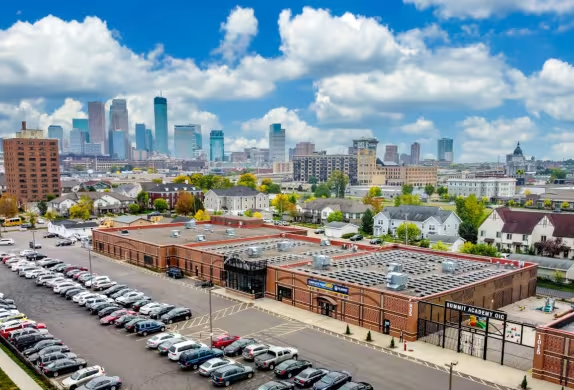
Transcript: We Are Summit
MIRIAM WILLIAMS: We need people to go to work. We need people to love these jobs, and we need people to want to be on the career paths that we provide here. And I think that's the reason why I enjoy coming to work every day—that I get a chance to see that happening for a student every single day.
LEROY WEST: We provide them with the skills and train them on the skills to then give them that job so that they can be successful in life, and move out of poverty, and take care of themselves, take care of their families.
DONALD STEWART: Summit gave me a new lens on life. I can help myself, my family and friends, and build a life for myself rather than me just working for a paycheck and living hand-to-hand.
LOUIS KING: Now you have the pandemic, a technology explosion, and what they call the ‘sans’-demic, without people. We don’t have enough people. So, people, hear this: They need you. Get a skill, get something that you can trade across the table in the market place, so that no matter what happens somebody needs you.
LEROY WEST: You know, creating a GED program was a lot of, you know, effort and funds, you know, to do that. And we did it, and it proved to be very successful. We’re one of the top GED programs in the state.
CHARLES HAYES: People just kind of assumed that I had that credential, but I didn’t. And I wanted to have it because it feels better, and I wanted to walk the walk. I was like, “Man, why did I wait so long for? I could have knocked this out a long time ago.”
LOUIS KING: You come in here you meet a different set of people. They’re all trying to get somewhere. That’s a change. You actually acquire skills and education. That’s a change. So all this metamorphosis takes place over the 20 weeks.
JAMIE GUALLPA: It’s just getting closer to the promised land. They just told you that, like, trust the system. Sure enough, like, I was able to power through to graduation and am going from not being able to pay my bills to thinking about my future. I’m no longer stuck in the present. It’s nice to think about a future now. It’s a privilege I don’t think I’ve had for quite some time.
LEROY WEST: It’s like, Summit and the construction program. Summit is known for that. And we’ve built that, and that’s matured. IT is next. There’s no doubt that the future workforce is IT.
LOUIS KING: So Summit had to get into help desks, had to get into network operations, and had to get into app development. All the things that make today’s corvette run. We want to be the people who are there and provide our students with access to those tools.
DWYNE SMITH: For me, this was completely brand new. And so, the more I realized, as I was going through the program, what I was getting into was more than just some money. I was getting into job security.
MIRIAM WILLIAMS: It’s important to introduce kids to STEM because that’s where the careers are. It’s where everything is headed. I’ve seen what good solid programming can do for a community, and I think it’s important on the north side of Minneapolis because you can’t get enough educational opportunities to serve all the kids there.
I think the thing that has allowed us to make all of these changes has been contributions from philanthropy. It’s been the corporate sponsorships. Some of the things that we’re hoping our sponsors will do for us and with us would involve things like supporting our students and the programming that they’re in.
LEROY WEST: We need more employers. Employer engagement is huge for us. What Atomic Data and U.S. Bank have done… When you really engage like how they’ve engaged with us, we pretty much set our employer standards around that.
ANDREW BINGENHEIMER: When we build talent locally and bring talent up, we create that talent. We create loyalty. We create strength within our community.
MALLORY MONGE: We don’t want this to be proprietary to ourselves because that doesn’t benefit the community at large. And that’s the goal here, right? It’s to make sure that the community itself is prospering and growing and that individuals who haven’t ever thought of IT are thinking about IT now, and that they have a pathway to be successful within that career.
LEROY WEST: That’s what I think what separates us from other schools and organizations. At our school nobody pays one cent out of their pocket to come to Summit. That’s why we annually raise funds and [start] contracts, and we get the support from our corporate groups is because it’s not about us. It’s about them.
CHRISTEN WINSOR: I struggled with homelessness for a while while I was in school and I didn’t have any support from my parents financially while I was in college, so I’ve had a completely different situation at Summit where, you know, throughout the whole process people are making sure that I’m getting what I need.
JENNIFER SPRYSHAK: It’s definitely one of the things that drew me. It’s definitely a once-in-a-lifetime kind of opportunity where you have somebody that believes in you and your success and wants to remove all of the barriers that they can for you. I think that doesn’t come around very often in your life.
LEROY WEST: You know, we have people who come from all walks of life. You know, you can’t take a pencil and erase them off the planet. You just can’t do that. But, what you can do, is open your arms and your hearts to them and say, “Here’s the space for you, and we can help transform your life.”
LOUIS KING: You need more Summits doing this work. If you can’t get more Summits, then find a way to leverage what Summit does and spread it to those places where people don’t have the opportunities.