
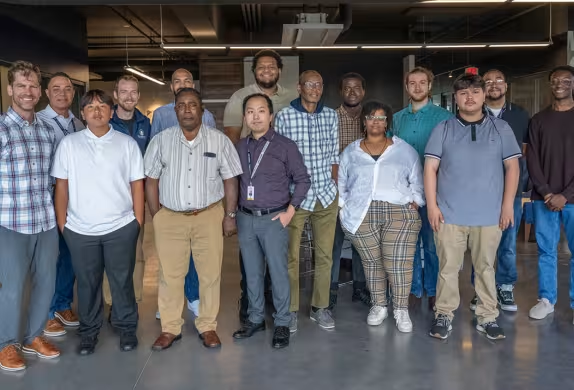
For our graduates, Summit Academy is a stepping stone into new careers, lasting connections, and personal growth. Summit’s impact is amplified through strong employer partnerships, like the one with Ameriprise, where 14 Summit alumni are building their careers and nearly all have already earned at least one promotion, with many advancing multiple times.
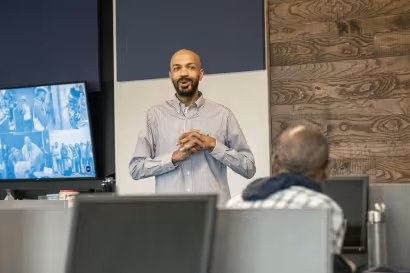
Recently, four of those alumni returned to the classroom to share their stories, lessons, and advice with current Financial Services students—showing how collaboration between Summit and employers can open doors and spark continued success.
Q: Coming through Summit’s Financial Services training, what do you feel benefited you the most, in a practical sense?
Mataly: I would say, honestly, it was going through the motions of applying for jobs. I think that was something that I was very interested in grinding out by myself, but having a space where everyone was interested in looking for jobs, just having a space where I could discuss things with other people, it gave me a lot of insight into the application process and how to best go about it.
Wyatt: The more that we learned about everything that we're going to be doing—not only the financial stuff, but also the professional side of things like learning how to hold yourself in a professional workplace, learning how to build a resumé, and build a good case for yourself when you go to apply to jobs. That really helped out.
I'm really liking what I'm doing. I could honestly see myself being in this position for a very long time. My time at Summit taught me a lot of things, and now I’m in my next big chapter with Ameriprise and kind of setting up my whole professional life.
Q: What did you take away from your IT training and experience in tech, and how do you apply it to your job today?
Mark: Something you study in tech is process change. How do we take something that’s not optimized and make it better? At our company we call that process LEAN, and I’m a leader of LEAN within my part of the business. I train on LEAN to help people recognize, where is there opportunity? How do I execute change?
That was something that I really learned and spent a lot of time on: how do we create process change to make a better product? That mindset of, how do I meet the needs of my customer? How do I meet the needs of my company? What can I do to add value? Once that's your mindset, you can go anywhere. That was something that I studied here, that I thought really paid off professionally.
Albert: For me, personally, I’m the tech guy on my team. Even if it's something simple as how to do something in Excel. Especially if there’s going to be updates, my team looks to me and says, ‘Oh, how does this work?’ because they know that I’ve probably dived into it to try to understand it so I can help teach and promote and then coach and contribute to my team.
Q: What skills did you take from previous jobs that have benefited you in your current role?
Mataly: In high school I was working at Starbucks, and I remember I came home one day telling my dad that my job’s kind of stupid. He told me every time you're doing something, there is something that you can learn. There's something you can take away from this. And if you don’t take away anything from what you’re doing, that was wasted time. That's something that I've really been trying to cultivate in myself since I was working small jobs in retail.
I think it also gave me the opportunity to learn and helped me build up those communication skills. I would say, that's probably the foundation of my skill set. If there's anything that I would say is number one, this is the thing that I'm good at, it's communicating with others. It's making connections and deepening those.
Wyatt: I first worked at Caribou, then I went to Starbucks, and in those positions you learn hard skills for food service. But it’s not only that. There are a lot of soft skills that you learn. I learned teamwork—I had to work with my team all the time. I learned a lot of customer service too, because customer service is an important thing to know.
There's a lot of soft skills that come from everything that you do. Every hard skill has two or three soft skills behind it. So it might not always be easy to see, but they’re everywhere.
Q: How would you recommend preparing for the Securities Industry Essentials (SIE) exam?
*The SIE exam is an entry-level exam that assesses a candidate’s knowledge of basic securities industry information including concepts fundamental to working in the industry. It is administered by the Financial Industry Regulatory Authority.
Mataly: The biggest thing for me was taking a lot of notes, going over the notes, asking Adam about your notes, taking the quizzes, going back to Adam and asking about them. He’s been in the industry 10 years. The more I learned about finance, the more I realized how good he was at breaking all of these things down into simplified ways to understand. He was instrumental in my getting my SIE.
Try to make sure you can understand the question underneath the question. They're going to phrase things in ways that are intended to confuse you. You have to look at a question and get to the root of it.
Wyatt: Take advantage of every moment that you have in the classroom, but also give yourself a break when you're not in a classroom, because your brain does need that break to rest and also for processing information in the background. Once you get into some more of the later chapters, go back into the first ones, not only to not forget what you've already learned, but also to reinforce your understanding. The whole work kind of works together with itself.
Q: What is one thing you learned at Summit that you apply every day?
Albert: To be honest, keep open. When one door closes, there's always another door that needs a key to open. When you go through the series of life and your different obstacles and challenges, it's okay to reset. It's okay to get knocked back down nine times and make sure you get up ten.
Mark: You have to listen everywhere. You have to learn how to listen to whoever's in front of you and whatever they offer, whatever is on their mind. My customer has a need. My kids have a need. My spouse has a need.
Wyatt: One thing that I really learned here that I can take forward is how to take information and really use it. When I was going to school, Community College and even high school before that, I just kind of went through the motions. But this was my stepping stone to where I want to get to.
I really had to rewire my brain around learning and thinking about things to really take in information, not only about the financial services, but also about being a professional, learning how to hold yourself, learning how to do interviews. And in that rewiring, I found that it does help in a lot of other aspects of my life.
The stories of these graduates highlight the impact of strong collaboration between Summit Academy and Ameriprise. Summit provides students with the technical skills, professional preparation, and confidence to step into new careers, while Ameriprise offers the opportunity to put that training into practice and invests in our graduate’s growth and continued success. Together, this partnership is creating a clear pathway from classroom to career for IT and Financial Services students.